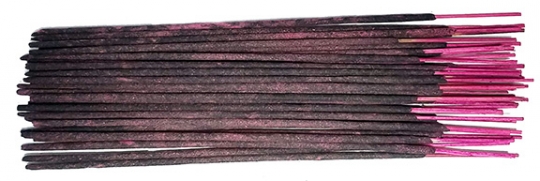
No matter how much we try, some incenses defy us to easily define them. Amethyst Incense is one of those most challenging selections to describe. It’s such a remarkable fragrance that it’s well worth a try. Since it is made by Haridus Madhavdas, the same manufacturers as Egyptian, Superb Sandal, and Crystal Rose, it will have that buttery, amber, vanilla, basmati rice, toffee core fragrance that seems to run throughout nearly everything this manufacturer creates. From there, things get really interesting. It offers notes of frankincense, cleansing elements of lavender and a noticeable component of something like African violet. It’s such a complex, well balanced and intriguing fragrance that we ourselves probably use nearly as much as we sell. Amethyst Incense has developed such a following that it is not unheard of for some purchases to approach a full kilo at a time. Please do give it a whirl. We’re confident it will become a favorite. Interestingly, it also is known as “Extra Special Pride”, or “Super Pride” depending on where it is found.
Tag: Incense
-
About Jah Love Incense
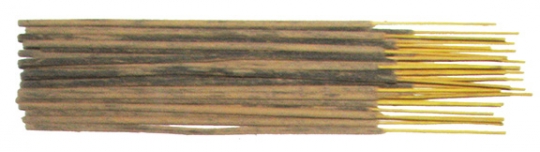
There can never be too much love, and there can never be too many champa incenses. It’s but one of may rules we live by. Jah Love is indeed a classic champa incense. So you ask, “What is a champa incense?” A true champa is defined by the presence of one key component called “halmaddhi”, sometimes spelled “halmaddi”. It is a sap from a very specific tree that lends its unique, sweet, spicy, floral element to incenses. Once one has had a few halmaddhi incenses, they will be able to spot it right away. One of the tell-tale signs is that the sticks rarely completely dry out. Halmaddhi has a way of always remaining slightly damp by attracting water right out of the air, so champas tend to be somewhat soft and damp to the touch. Jah Love certainly is one of the few remaining halmaddhi-based incenses along with other classics such as Raj Laxmi, Sairanjani Champa, Nitiraj Natural Masala, and Shanthimalai Nag Champa as examples.
-
About Balaji Chandan
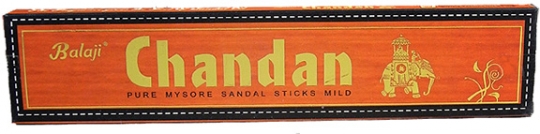
Chandan is fancy talk for sandalwood. There are likely thousands of different sandalwood incenses. We ourselves probably have a few dozen, each so very different from the next. One of our very favorites is Balaji Chandan. We weren’t surprised as the entire Balaji line is so wonderful. It’s a fairly potent sandalwood fortified with sandalwood oil. This offers a considerably richer, more complex profile to the fragrance. Its quality more accurately matches incenses that cost nearly double, but that’s a secret we all can keep. When we sampled it, we expected it to be considerably more costly given its depth, but who are we to argue when the price is right? It’s an absolute must-have for not just sandalwood enthusiasts, but for anyone who enjoys quality incenses.
-
About Vijayshree Golden Nag Champa Cones
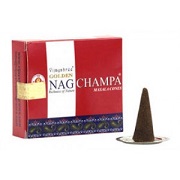
We don’t have many cone incenses. The truth is, there aren’t many that impress us. Granted, they serve a purpose, giving a fairly significant amount of fragrance off in a shorter time. They tend to be cleaner than sticks as their ashes are easier to contain. What is unfortunate is that many of the better sticks cannot be formed into cones for various reasons. One reason is that the makeup of the incense requires a bamboo backbone to keep it together. It would be too soft or crumbly to hold together as a cone. Some just wouldn’t burn right. More oxygen is needed to keep the stick lit, so if it’s in cone form, the cone would burn for a while then go out part of the way down. Nag Champa has both problems. It’s crumbly and it has a fairly high O2 requirement, so that is why Nag Champa cones seldom resemble Nag Champa. They have to be formulated differently for both structural and combustive reasons. This hasn’t stopped manufacturers from making cones called “Nag Champa”, but few come at all close to the stick form. Out of the ones we have tried, Vijayshree Golden Nag Champa Cones comes the closest. Once one’s expectations are such to appreciate a fragrance for what it is, rather than comparing it to another, these might just be our over all favorite cones. How close does it come to Nag Champa? We would say close enough that they have earned the right to put the title on the pack.
-

About Satya Patchouli
There are dozens of different Satya incenses. We have our share of them, but we don’t have them all by far. Nearly all of them, with a few exceptions have a similar core fragrance, that being a medium bodied, semi-sweet amber, vanilla-like quality. From there, each has its variant on that theme. They have three differing patchouli variants, Satya Patchouli, Satya Patchouli Forest, Satya Natural Patchouli, and Satya 60’s Patchouli. All three are wonderful in their own right. Of the three, Satya Patchouli is the most straightforward in its approach to patchouli. It has that classic semi-sweet core that we expect, but to set it aside from the rest, it has a noticeable element of earthy, rich patchouli. The manufacturers recognize the quality of this particular offering and have made it available in 40g packs. That is reserved for only a dozen or so of their fragrances. If you’re a nag champa fan and a patchouli lover, this is an intuitive choice.
-
About Our Incense Sleeves
Normally, we would feel a twinge of remorse packing up all of these incenses, giving out samples and all of that and create such a mess with so many plastic sleeves. That’s one reason why we use cellophane rather than plastic. Plastic is much easier to come by, and it’s considerably less expensive, but cellophane will biodegrade. In fact, they are so biodegradable that if we keep sleeves around for more than a year or so, they are already beginning to break down. Another reason we use cellophane is that it provides a far superior barrier for fragrance than plastic. Many fragrances are oils or are fairly oily. Plastic is somewhat permeable to these oils and the incense wouldn’t be as fragrant after a while. Cellophane is actually a polymer of glucose, and if anyone has tried to dissolve sugar in oil, they’ll find out they cannot. So these oils are repelled by the sugar-based makeup of cellophane. Cellophane also is permeable to moisture, so damper, fresher incenses won’t mildew. The easiest way to test if someone is using plastic or cellophane is the flame test. If it melts, curls up, sometimes it may drip while it’s burning, safe to say that’s plastic. If it burns more like paper, no dripping or curling up but perhaps a carbon residue, it’s cellophane. Hopefully we’ll be able to keep using cellophane. Sources are getting more and more rare each day.
-
About Mystery Packs of Incense
We do get asked now and again, “What’s in the mystery packs?” We appreciate irony as much as the next guy, but it does bring up a real question, “What really is in the mystery packs?” Many of the incenses that we weigh out into packs end up with a small portion that isn’t enough to make a full pack, packs of discontinued items, and the remains of packs that we opened ourselves to sample out all begin to add up after some time. This is what ends up in mystery packs. So it’s not cast-offs, it’s all legit incense that we just don’t know what to with. The good thing about mystery packs is quantity. There’s a generous 35g in each pack. Another good thing is that it varies so much from stick to stick. The downside is that the fragrances tend to blend together, so if you find something you like and in the chance we can identify it, new sticks of the same type will be different. We use them for road trips when we want variety without carrying many packs. So go with the flow, appreciate the impulsive nature of our mystery packs.
-
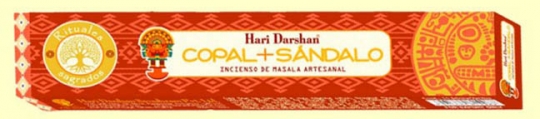
Hari Darshan Copal + Sandalo
One of the perks of what we do is that we get to try out all kinds of new incenses. Sometimes it’s not much of a thrill, but now and again, something comes up that wows us. Hari Darshan Copal + Sandalo Incense is one of those items that we checked out and went gaga over. Its depth, richness, and complexity is that of incenses that can easily cost three times as much. It has the qualities of some of the higher end resin based stick incenses and more. It’s not just dry resin and sandalwood. It has amber elements that sweeten the deal and really permit this incense to feature piney, clean copal and cooling, meditative sandalwood. The sweeter element provides a perfect backdrop for the resinous notes and sandalwood. We have a few others in the Hari Darshan line and we’ll eventually have them all. They’re that good.
-
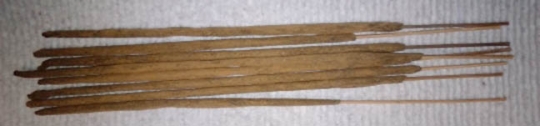
Tree of Life Champa
We love champa incenses. This isn’t something that we keep as a secret. We’re always looking for another one to add to our selection. When we found Tree of Life Champa, we knew it had to be part of our library of incenses. This offering is from the Tree of Life company that also produces the wonderful and powerful Mars Choice and Champaka, so we knew it would be solid before we even tried it. It’s such a wonderful classic champa incense. It’s rich, complex, satisfying, semi-sweet, full of spice and distant florals. It gets much of its fragrance from that key component called “Halmaddhi” that defines champa incenses and distinguishes them from others. Please, if you’re a champa fan, or even just an incense user, Tree of Life Champa needs to be experienced.
-
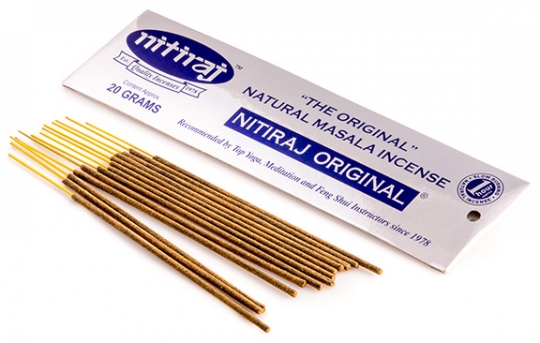
Nitiraj Natural Masala Incense
Over the years, there have been many champa incenses, all of such varying quality. The classic that we all know so well, the famed blue box Shrinivas Sugandhalaya has undergone so many changes since the 90s that it is nothing similar to its original formula. It’s still a good fragrance, but it has changed so very much. A champa that we have come to love so much, Nitiraj Natural Masala Incense, thankfully hasn’t changed as long as we have known it. It’s a classic champa, meaning what? A true champa should include a key ingredient known as “halmaddhi” (the spelling of which can vary). It’s a sap from a specific tree, much like other sap incenses like frankincense or myrrh. It carries a unique fragrance that is semi-sweet, somewhat spicy, and somewhat floral. Halmaddhi defines this incense. It is right up front. It captures the scent of headshops and black light rooms and 60s pads. It’s like a time machine in a stick of incense. If you’re a champa fan, please do give this selection a go.