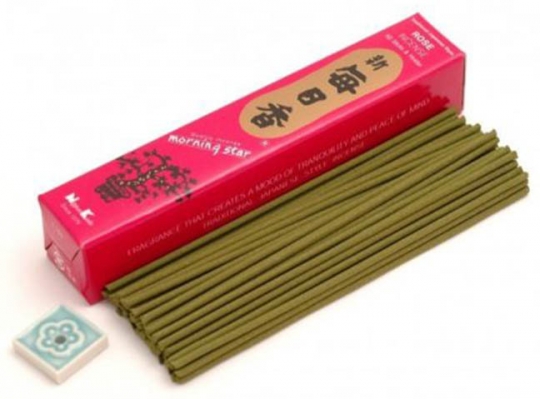
Morning Star Sandalwood incense has been around for so very long and has remained unchanged. It’s a classic example of a Japanese sandalwood incense. It’s very light, dry, clean and cooling. It is an incense that can be appreciated even in small rooms as it doesn’t give off much smoke and the fragrance its self is so light, gentle, and non-perfumey. It can even be enjoyed by those who are especially sensitive to perfumes, those who get that headache when exposed to heavy fragrances. Morning Star Sandalwood carries its self with dignity and sophistication. A small tile designed for burning this incense, but to be safer, it’s best to set it on a fireproof surface.
Category: Blog
-
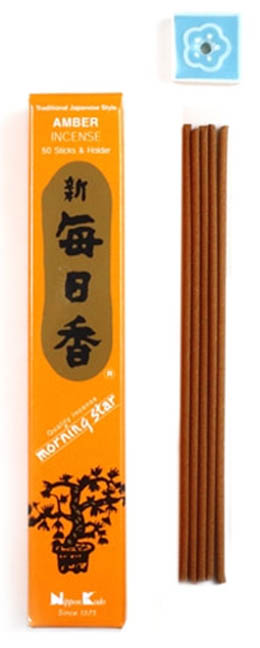
About Morning Star Amber Incense
Morning Star incenses are all bout theme and variation. All of them have the same gentle, clean, sandalwood core that is distinctive to the line. Morning Star Amber differs in that it has a soft, semi-sweet addition of amber resin. Amber warms up what would otherwise be a cooling sandalwood. It rounds out the fragrance and sweetens it ever so lightly. Morning Star Amber is gentle and light enough to appreciate even in small environments. It’s not heavily perfumed, so those who are sensitive to perfumes can enjoy Morning Star Amber. Each pack comes with a little to tile to set the sticks in, but we still recomend putting it on a fireproof surface.
-
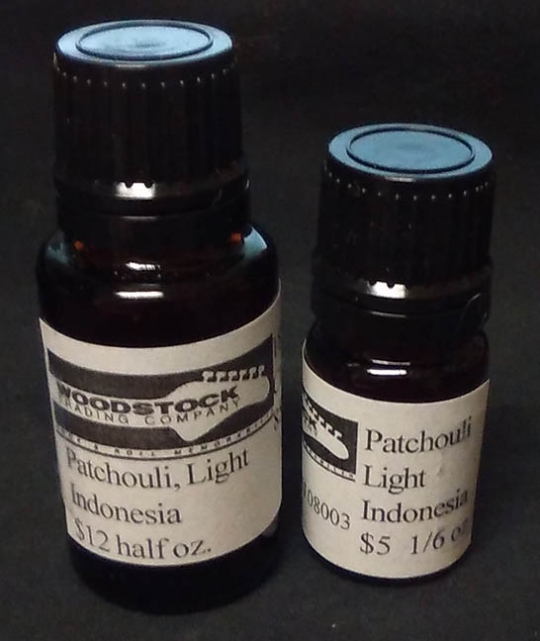
About Patchouli, Light Essential Oil
When we published our blog on the subject of Patchouli, Dark Essential Oil, it created an interest in the contrasting Patchouli, Light Essential Oil. Just how different are they? They are like day and night. Patchouli, Light Essential Oil is brighter, less sweet, more assertive, “hotter”, and greener in fragrance than dark patchouli oil. It also has a note to it that is akin to white pepper. Dark Patchouli oil is sweeter, softer, and earthier. Which one is better? That’s purely up to the nose of the individual. We will even wear both to get the best of both worlds. As it ages, it mellows considerably and becomes less “hot”. It actually will begin to resemble dark patchouli over time.
-
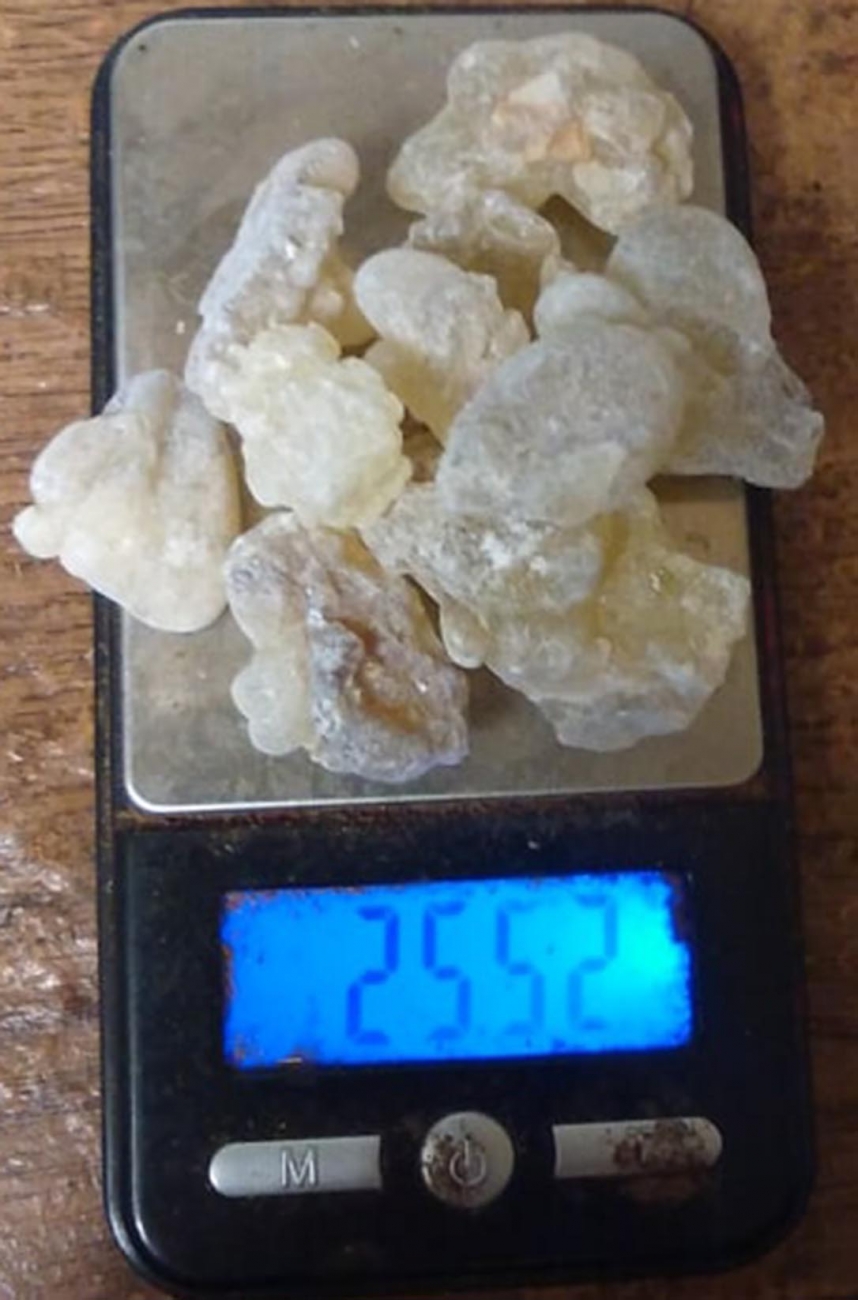
Royal Hojari Frankincense
Frankincense can come from many places such as India, much of Northern and Western Africa, and others. Out of all of the sources of frankincense, The Emirate of Oman still is producing inarguably the best of the very best frankincense. The grading of frankincense is involved, but to cut to the chase of it, everyone wants to know what is the best and just where can it be found. The tippity top of the pyramid is Omani Royal Superior Hojari Frankincense Incense.
It was a bit of a dream to be able to offer such frankincense as it’s cost tends to be prohibitive, but we found an excellent and very kind source that offers such incense at a price good enough for us to carry it now and again. It’s not a steady item, we don’t always have it, so check with us before a road trip for Omani frankincense. If you are a frankincense fan, grab it when you can.
Once set on the charcoal, it will be obvious within seconds that this isn’t ordinary frankincense. This is some next level stuff. It’s exquisitely aromatic, full of citrus, particularly a lime-like note and bergamot (Earl Grey Tea) that only the high end Omani frankincense can boast to have. There’s nothing else like it; it’s peerless in its beauty.
-

Smudging Without Sage
Sometimes one doesn’t want all of the smoke nor wants to deal with the process of smudging with sage. Thank goodness there are options. Some incenses contain sage as a key component, permitting one to purify their environment without sage bundles. One of our favorites is Sandesh White Sage. It has a lovely champa-type core with the addition of white sage. Don’t look for an over-the-top white sage burst; it’s considerably more subtle than that. Another one we have fallen in love with is the wonderful Hari Darshan Copal + White Sage. It combines a lovely semi-sweet amber core with the piney, cleansing property of copal and an earthy note of white sage. We also have these wonderful contribution of HEM White Sage Masala Incense. It’s a dry-type masala incense with notes of white sage. If you want something else exciting, we have a white sage incense with the crisp, clean addition of juniper, go with Sacred Elements Juniper & White Sage Incense. So all is not lost if you wish to smudge without having to deal with sage bundles. We have options-a-plenty.
-
BLOG ALTON KELLEY
 One of the icons of psychedelic art, Alton was born Jun 17, 1940 in Houlton Maine. He spent his childhood in Connecticut. Art was his passion and he honed his craft at art schools in Philadelphia and New York. His career blossomed in San Francisco where he lived in Haight-Asbury which was the nucleus of rock music and art.
Alton’s collaboration with Stanley Mouse in 1966 gave both artists a chance to merge their talents. They developed distinctive images we all recognize. They worked in a unique side by side at their drawing tables with Mouse on the right side since his drafting skills were stronger with Kelley doing layout. Mouse and Kelley worked quickly producing a poster a week. They produced album covers for the Grateful Dead, Steve Miller Band, Quicksilver Messenger Service, Jimi Hendrix as well as poster for the Avalon Ballroom and the Fillmore. The last time they collaborated for the cover art for the induction ceremony at the Rock & Roll Hall of Fame in March 2008
We lost Alton Kelley in June 2008. Mint condition posters are selling for thousands of dollars. It is a testimony to the fame Alton Kelley never dreamed of having.
Mom & Seth had the opportunity of meeting Alton Kelley at a rare gathering of famous Psychedelic artists in San Francisco in 1989. It was a thrilling moment in time never to be duplicated.


-
STANLEY MOUSE

Photo taken by Mom 1989 at the ART benefit concert sponsored by Jerry Garcia for the psychedelic artists It has been a special treat for Mom & Seth to be involved with this sp concert that was sponsored by Jerry Garcia. It was to raise funds for the legal fees of the early psychedelic artists so that they could be fairly paid for their work and also have the ability to reproduce some of the art. Stanley Mouse was one of the big 5 that designed the art work that helped to define a special style of art that will live forever.
Leaving Detroit where he grew up he arrived in San Francisco in late 1965. He was doing a lot of airbrush work. He was painting hot rods on t shirts at fairs. He was fascinated by the weirdo hot rod art movement. In 1965 he settled in Oakland California and met Alton Kelley and this changed his life. He joined the red dog saloon gang who later changed their name to Family Dog. In 1966 Mouse & Kelley joined forces and produced poster art work for the psychedelic music scene.
Some of the very famous work that Mouse created over the years is the cover for Grateful Dead Family Album written by Jerilyn Brandelius, Scarab logo for the band Journey , and The Book of Dreams logo for The Steve Miller Band

Grateful Dead Family Album 
Journey Scarab Logo 
Book of Dreams Logo for Steve Miller Band -
WES WILSON FATHER OF PSYCHEDELIC FONT
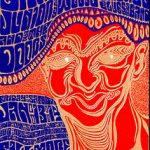
In psychedelic art Wes Wilson’s art helped to define the psychedelic style that defined the era of the 60’s and 70’s. In fact he is generally acknowledged as the father of the 60’s rock concert poster. His poster feature his admiration and respect for the feminine form and are considered to be an enduring representation of the entire period.
It is about the recognizable balloon shaped writing with complimentary colors right next to each other in very exciting ways. He wanted a poster that people liked to look at. He wanted to use up all the space on the poster. His art was based on a combination of a whole bunch of things and all based on his idealism that things are going to get better.
Wilson’s idealism had him doing posters and fundraising for the “Appeal”and the Merry Prankster Acid Tests were dance hall concerts to benefit anti involvement in the Vietnam War. He was also doing posters for, the Family Dog, Fillmore Auditorium. In May of 1967 he had a dispute with Bill Graham over money and Wilson no longer did posters for Graham. However, he continued to produce posters the Avalon and other venues.
Seth and I have had the good fortune of meeting Wes and have a few of his postcards available for our customers. They will not be on the Website and you can call Mom at 856 424 6166. At this time I have 4 of each of these post cards “The Sound” which 8” x 4” and Grateful Dead Fillmore Jan. 1967 5 1/2” x 3 ½” . I also have in my personal collection a copy of his newsletter that was a tribute to Rick Griffin which is not for sale .
-
Rick Griffin
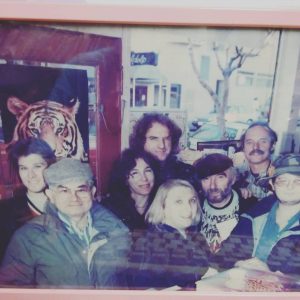
Mom, Seth Randy & Doc at Postermat with Rick Griffin, Bob Schnepf and Ben Friedman circa 1989 Rick Griffin was born near Palos Verdes, California June 1944. During his childhood he would accompany his father, who was an archaeologist on digs in the Southwest. His exposure to Native American and ghost town artifacts influenced his art work. He was introduced to the art of surfing at a very young age, this along with his love of cars and motorcycles were influences in his professional art work. His character Murph the surf was well known in surfing circles.
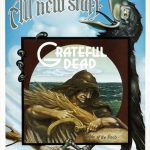
Destiny played a profound roll in his life at the time he was about to leave the US and emigrate to Australia, Rick hitched a ride and was involved in an auto accident that left him near death. He remembers hearing the words of the 23rd Psalm. In later years this event proved a factor in his later conversion to Christianity. The event also caused his left eye to be dislocated and it is thought that this influenced his characteristic fluid lettering.
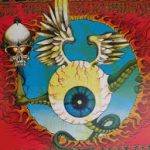
In 1967 he produced a poster for the Human Be-In in Golden Gate Park this was advertised as the “Gathering of the Tribes” and as the Summer of Love continued he was in high demand. He produced a series of posters for Chet Helms,( Family Dog) and Bill Graham (Avalon Ballroom and the Filmore).
Along with Alton Kelley, Stanley Mouse, Victor Moscoso and Wes Wilson, he became known as one of the “Big Five” of psychedelia. In 1967 they founded the Berkeley-Bonapart distribution agency to produce and sell psychedelic poster art. The famous “Flying Eyeball” poster is among one of the most important of contribution to the psychedelic art movement. In the 70’s he produced the illustrated Book of Saint John and later created work for the Calvary Chapel in Costa Messa.
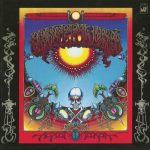
It was on August 15, 1991 that Rick placed a phone call to the Robert Beerbohm’s gallery from a payphone in a grocery store. He learned that one of hjis paintings had just sold for $1800. On his way home he was forced off the road by a van and he died three days later from his injuries.
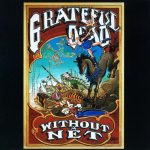
I am so happy to have had the opportunity meet him and know that his work will be appreciated for generations to come. His loss was overwhelming he was a true visionary and an outstanding talent.
Many of his art work is represented in Woodstock Trading Company in poster, magnets, clothing and products for the home.
-
THE BEGINNINGS OF PSYCHEDELIC ART
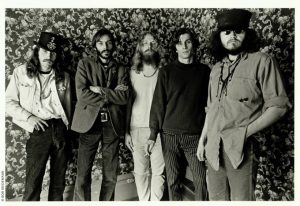
The “big Five” San Francisco poster artists Lto R Alton Kelly, Victor moscosso, Rick Griffin, Wes Wilson, Stanley Mouse. Photo by Bob Seidemann Where would psychedelic music be without the art that accompanied the sound of visual experiences that represented the spirit of the times from then until now and into the future, forever!
When you think about psychedelic music do you not automatically think about the art that accompanied and enhanced the experience? It is probably the time around 1966 to 1971 when the San Francisco Music Poster had its impact in the arena of graphic art. This resulted in all sorts of posters, handbills and flyers advertising rock concerts
Bill Graham, who promoted concerts at the Fillmore Auditorium, Winterland and a dance hall he renamed The Fillmore West along with Chet Helms, who headed an organization called The Family Dog, were influential in having art posters that “rocked the world” to help promote their shows.
At this time there were a handful of San Francisco artists that were commissioned to produce much of this art work. The had become known as THE BIG FIVE. They included Wes Wilson, Alton Kelly, Stanley Mouse, Victor Moscoso, Rick Griffin. Their influences were that of the masters in the Art Nouveau moment In addition, Mouse and Kelly had some expertise in advertising art.They founded the Berkely-Bonaparte distribution agency to produce and sell psychedelic poster art.
Outside of Moscoso, who taught lithography, the artists had no formal training in printing techniques and it was the wonderful pressmen of firms like Tea Lautrec Lito and West Coast Litho that helped to produce the art work we have come to love and recognize.
Further Blogs are being written about each of the artists…keep in touch